
American avocet Eastern Oregon
$ 49.50
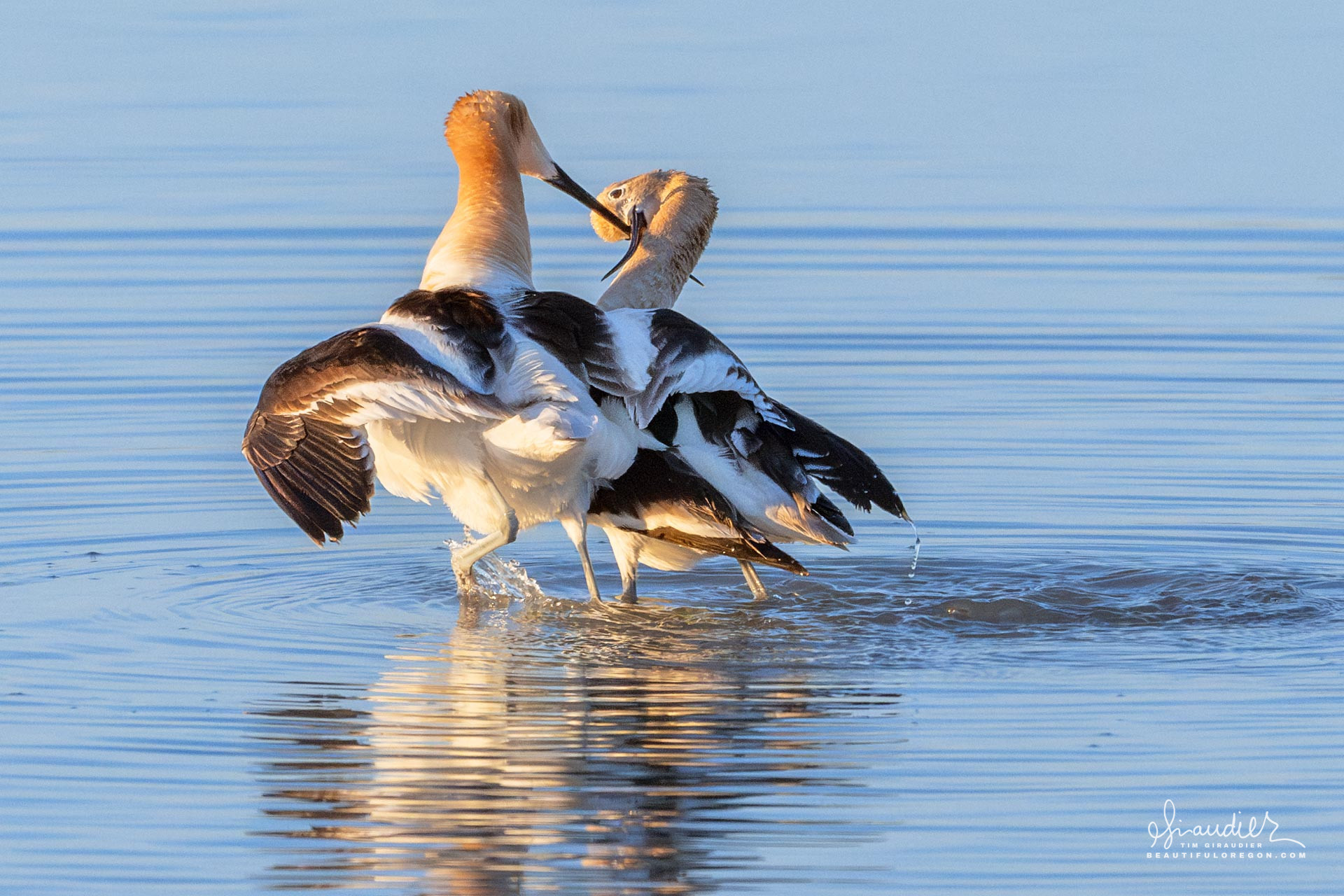
& Free Shipping: UK £40 | EU £50 | Intl £55A mated pair of American avocet (Recurvirostra americana) engage in an elaborate and beautiful courtship display at Summer Lake Wildlife Refuge. Lake County, Southeast Oregon. Mating Behavior of the American Avocet, with Observations from Summer Lake Wildlife Area The American Avocet (Recurvirostra americana) is a long-legged shorebird of the Recurvirostridae family, widely distributed across North America’s interior wetland systems. Known for its striking breeding plumage and recurved black bill, it is also noted for a highly stylized and observable courtship and mating sequence. These behaviors are well-documented in open, shallow alkali wetlands like Summer Lake Wildlife Area in southeastern Oregon, where avocets are regular spring and summer breeders. Avocets are seasonally monogamous, typically forming new pair bonds each breeding season. Courtship begins shortly after arrival on the breeding grounds, which at Summer Lake occurs in mid to late spring depending on wetland water levels and ice melt. Courtship behavior is elaborate and includes several clearly identifiable stages. One of the earliest is the synchronized head-dipping or “mimic foraging” display, during which both individuals rhythmically sweep their bills side to side in shallow water, simulating foraging behavior. This movement is not directed at prey but at the prospective mate, establishing synchrony and signaling mutual receptivity. This display may occur repeatedly in the hours or days leading up to copulation. Pre-copulatory Display, The Preening-Splash Ritual: When a pair bond is established and copulation nears, the behavior escalates to what is often referred to as the preening-splash display. The female signals readiness by lowering her head and neck low and forward, parallel to the water’s surface, adopting a submissive posture. In response, the male begins vigorously preening his own body, splashing water upward in an increasingly exaggerated and erratic fashion. This behavior often includes wing-raising and bill-flicking motions, increasing in intensity over a span of several seconds to minutes. This phase is not incidental—it is a necessary prelude that leads directly into mounting. Its exaggerated and choreographed nature suggests a strong role in behavioral synchronization and mate validation. Copulation and the Cloacal Kiss: At the climax of the preening-splash display, the male abruptly stops preening and mounts the female from behind, standing with both feet on her back while extending his wings for balance. He then lowers his vent and aligns his cloaca with the female’s in a precise movement known as the cloacal kiss—the technical term for the moment of genital contact and sperm transfer in birds. This action, typically lasting only a few seconds, constitutes the act of fertilization. Post-copulatory Behavior, Wing-Over Walk: Immediately after dismounting, the pair may engage in a coordinated walking display, during which the male extends one wing over the female’s back as they move forward together in shallow water. This wing-over posture is brief but distinctive, and visually resembles an embrace. With their bills crossed, and looking intently into one another’s eyes, the two birds walk in tight synchrony for several steps before separating. This behavior is best described as a post-copulatory affiliative display, thought to reinforce the pair bond following mating. Following copulation, the pair begins nest preparation—typically a shallow scrape on a sparsely vegetated islet or exposed mudflat. Both male and female share incubation duties for a clutch that usually consists of four eggs. Territorial defense becomes more prominent in this phase, with both birds responding aggressively to intruding avocets and predators. Aerial chases, alarm calls, and threat postures are common. Chicks are precocial and leave the nest within 24 hours of hatching. They are able to feed independently but remain under close parental guard for several weeks. Summer Lake Wildlife Area in Oregon provides ideal breeding conditions for American Avocets: broad, shallow wetlands, low vegetative cover, and abundant aquatic invertebrates. Managed by the Oregon Department of Fish and Wildlife, the refuge supports seasonal drawdowns that expose mudflats and levees ideal for nesting. During spring and early summer, avocets are among the most prominent and vocal shorebirds in the area. Courtship and mating displays at Summer Lake are most visible in early morning and late evening, particularly in calm conditions when light, water surface, and bird activity align. Observers at the refuge can often witness the full sequence of behaviors—from synchronized dipping, to the preening-splash ritual, to copulation and post-copulatory walking—at close range, making this site one of the best inland locations in Oregon for detailed avocet behavioral study. American Avocet, Ecology, Lake County, Southeast Oregon, Summer Lake