
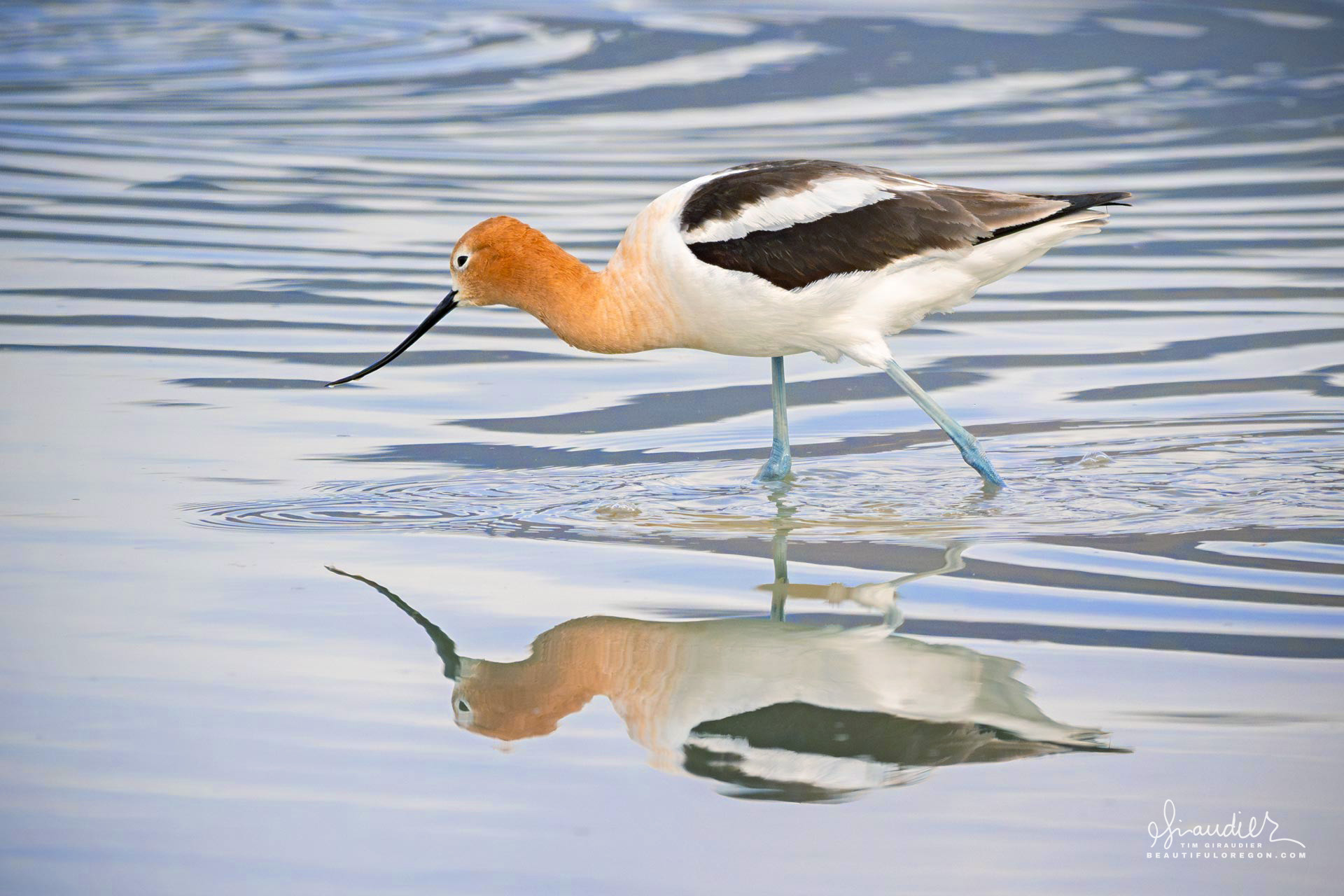
American Avocet Summer Lake Wildlife Refuge
$ 49.50
& Free Shipping: UK £40 | EU £50 | Intl £55Feeding Behavior of the American Avocet in Oregon’s Alkali Lakes: The American Avocet, with its elegant upturned bill, long legs, and striking plumage, is a graceful and highly specialized forager found throughout Oregon’s alkali lake. These shallow, saline wetlands—such as those in the Summer Lake, Abert and Warner Valley regions—are seasonal stopovers and breeding grounds that support dense populations of aquatic invertebrates, making them ideal for the avocet’s distinctive feeding behavior. American Avocets feed primarily by sweeping their slender, recurved bills side to side through shallow water. This tactile method, known as scything, allows them to detect and capture small prey by touch rather than sight. As they wade, often in synchronized lines or loose groups, they rhythmically move their heads through the water, stirring up aquatic insect larvae, tiny crustaceans like fairy shrimp and brine flies, and other invertebrates suspended just beneath the surface. In Oregon’s alkali lakes, which can be rich in saline-tolerant microfauna, these feeding grounds are especially productive. During breeding season, adults frequently forage near their nesting territories, balancing the demands of territorial defense and chick provisioning. As the season progresses and chicks hatch, the young avocets begin feeding on their own within hours of birth. Although initially clumsy, fledglings soon mimic the sweeping behavior of the adults. Their foraging takes place in very shallow margins where the water warms quickly, fostering high concentrations of prey organisms. Avocets also adapt their feeding technique based on water depth and prey type. In slightly deeper or more turbid water, they may switch to pecking at visible prey on the surface or dipping their bills quickly to seize individual targets. Their flexible feeding strategy allows them to thrive in alkali basin’s unpredictable conditions where water levels, salinity, and food availability fluctuate seasonally and even daily. These saline habitats, while harsh to many species, create ideal conditions for the dense invertebrate blooms that fuel avocet foraging. The birds’ presence is often tied to these food pulses, and large flocks may move among wetlands as conditions change. In this way, their feeding behavior not only reflects the unique adaptations of the species but also reveals the ecological richness and seasonal dynamics of Oregon’s inland salt lakes. Seen from a distance, a group of foraging avocets appears almost choreographed—fluid lines of motion across mirror-bright water. Up close, their precision and method reveal the evolutionary refinement of a bird perfectly adapted to the shallow, saline margins of the arid West. In this image, an American Avocet (Recurvirostra americana) gleans for brine shrimp and brine fly larvae amidst the shallow alkali ponds of the Summer Lake Wildlife Refuge. Lake County, Southeast Oregon. American Avocet, Ecology, Lake County, Southeast Oregon, Summer Lake