
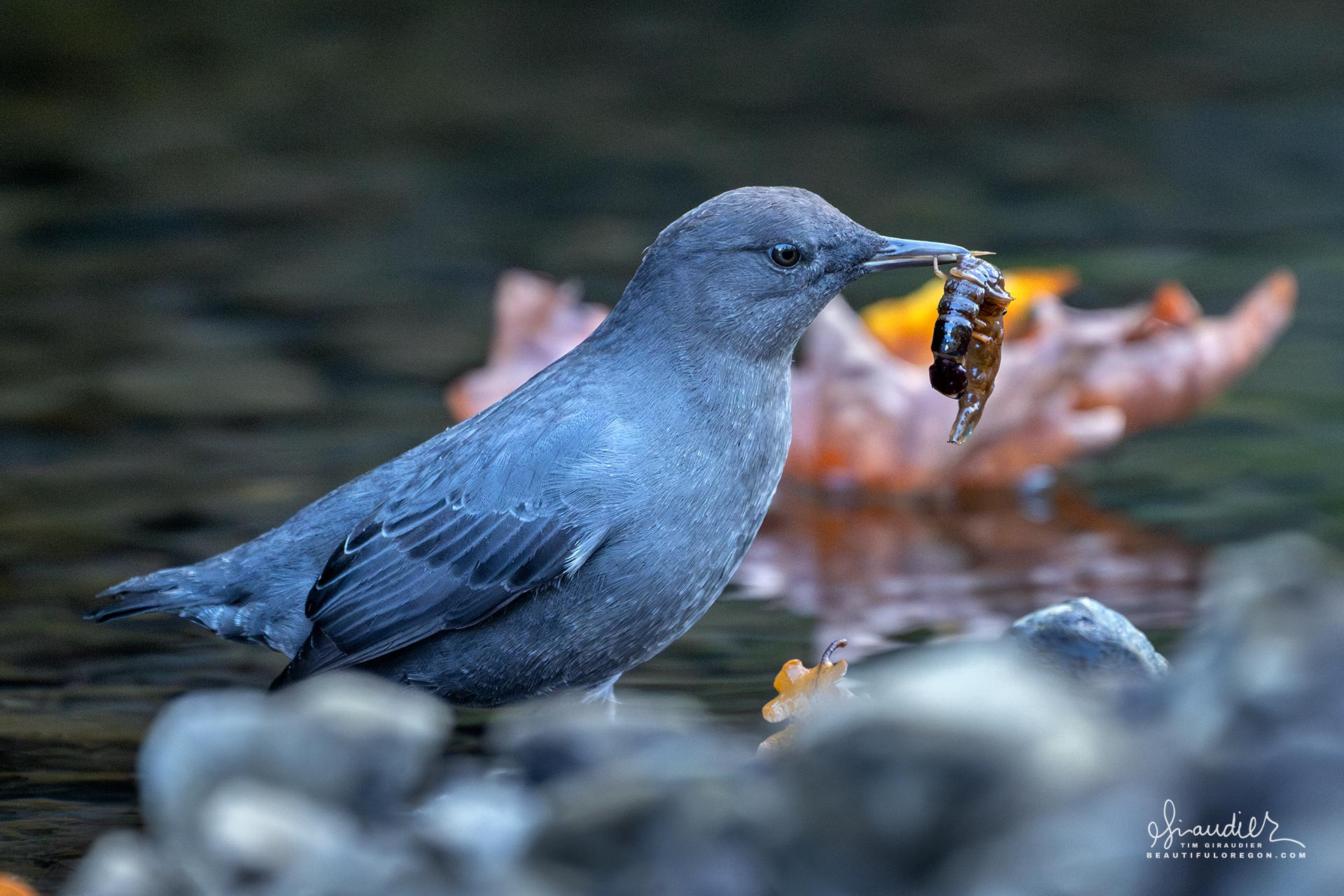
American Dipper with Stonefly
$ 49.50
& Free Shipping: UK £40 | EU £50 | Intl £55Starting in early October, I’ll travel around western Oregon to visit some of the state’s best salmon spawning streams. Amongst these, Eagle Creek, found on west side of the Columbia Gorge is my favorite. In low water years, which unfortunately is becoming more frequent, the lower reach of Eagle Creek might not see as many salmon trying to make their way upstream. When this happens, I turn my attention to watching the many birds which congregate here during the spawning runs. The species I most often see are seagulls, merganser, and in the case of this photograph, one of my personal favorites, the American Dipper! While they’re here specifically to glean for salmon eggs, in this instance, it has found a plump and nutritious stonefly. After about five minutes of repeatedly beating the aquatic larva on a river rock, the insect was then carefully broken, and eaten in two or three pieces. The American Dipper exhibits a highly specialized foraging strategy that is unique among North American passerines, relying almost exclusively on the high-energy environments of fast-flowing mountain streams. Its diet is primarily composed of the larval stages of aquatic insects, with a strong preference for caddisflies, mayflies, and stoneflies. These macroinvertebrates provide a consistent source of protein and are often supplemented by other prey such as midges, beetles, and small crustaceans. In certain habitats, the dipper also targets small fish, such as trout fry or sculpins, and frequently consumes fish eggs during active salmonid spawning runs. To access these food sources, the American Dipper employs several distinct hunting techniques that allow it to remain submerged against powerful currents. One of its most notable behaviors involves diving directly into the water and using its short, powerful wings to effectively fly beneath the surface, providing the necessary propulsion to reach the stream bed. Once at the bottom, the bird can walk along the rocky substrate by using its strong claws to grip stones while its wings provide downward pressure to counteract buoyancy. It often uses its beak to overturn small pebbles or probe into gravel and leaf litter to expose hiding larvae. The bird also utilizes simpler methods such as wade-plunging, where it stands in shallow water and repeatedly dips its head beneath the surface to scan for movement. When larger prey items like small fish or thick-bodied larvae are captured, the dipper typically carries them to a prominent rock above the waterline. There, it will vigorously beat the prey against the hard surface to subdue or soften it before consumption. This combination of physical strength and behavioral flexibility allows the species to maintain a high metabolic rate even in the near-freezing waters of its alpine and subalpine territories. American Dipper, Eagle Creek, Ecology, insect