
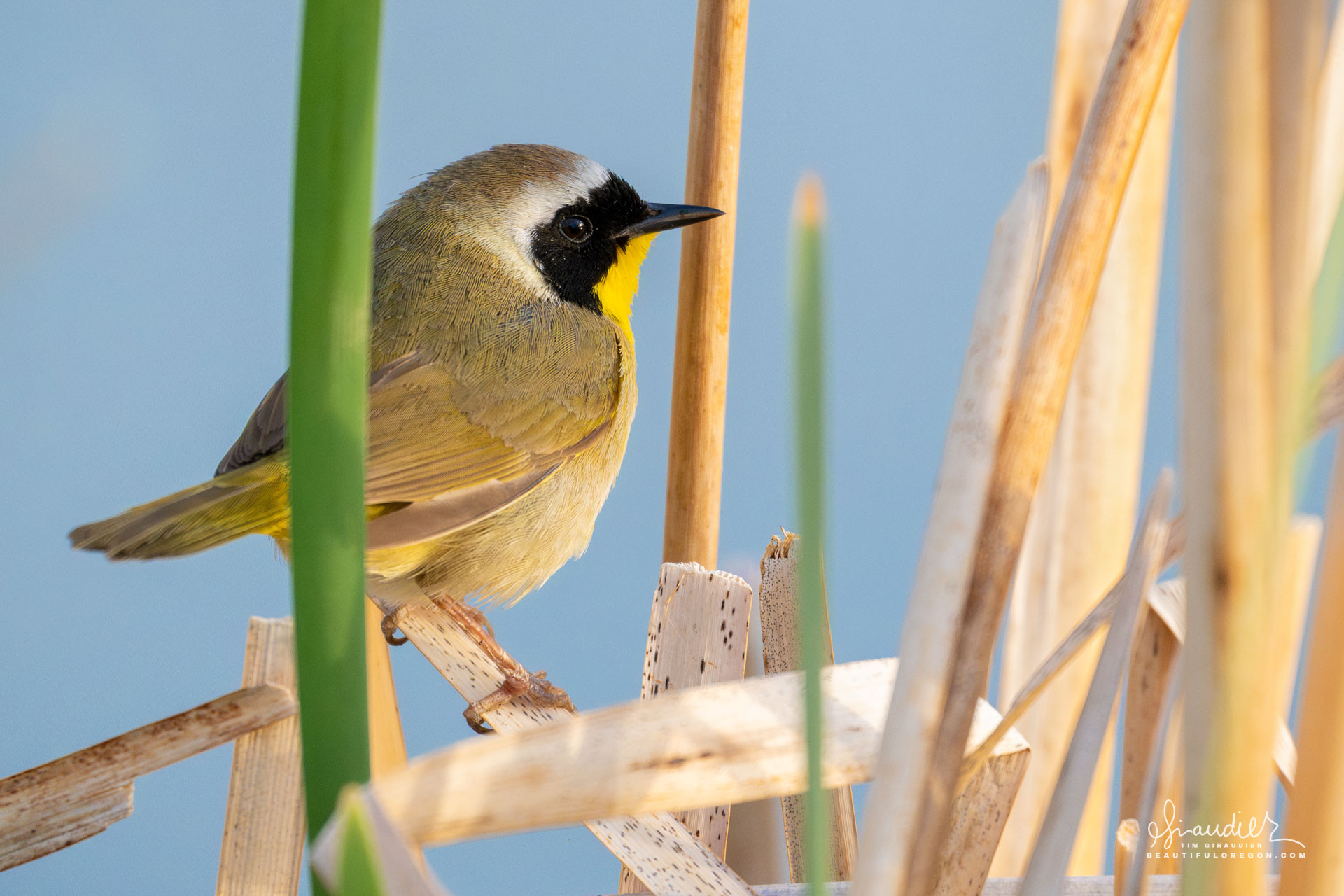
Pacific Common Yellowthroat – Summer Lake Wildlife Refuge
$ 49.50
& Free Shipping: UK £40 | EU £50 | Intl £55A Pacific Common Yellowthroat peers from the safety of tule reed in a marsh at Summer Lake in Southeastern Oregon. The Pacific Common Yellowthroat (Geothlypis trichas sinuosa) is a subspecies of the Common Yellowthroat, a small, warbler-like songbird found across North America. The Pacific Common Yellowthroat is native to the western coastal regions, particularly in California and the Pacific Northwest, including parts of Oregon. This subspecies has adapted to specific habitats along the Pacific coast, where it thrives in wetland environments. The Pacific Common Yellowthroat shares many features with its relatives but has some distinctions due to its habitat. Males are easily recognizable by their bold black face mask, bordered by white or gray, which contrasts with their bright yellow throat and breast. Females lack the black mask and are generally more muted in color, with olive-brown upper parts and a paler yellow throat and underbelly. Pacific Common Yellowthroats prefer dense, shrubby wetlands, marshes, and riparian areas. They are most commonly found in areas with thick vegetation near water, such as cattail marshes, reed beds, and overgrown pond edges. These birds rely on these dense thickets to provide cover for nesting and foraging. Like other yellowthroats, the Pacific subspecies feeds primarily on insects and other small invertebrates. Their diet includes beetles, flies, caterpillars, spiders, and other small arthropods. They are typically seen foraging low to the ground or near water, where they search for insects among reeds, grasses, and shrubs. The Pacific Common Yellowthroat begins breeding in the spring. Males sing energetically to defend their territory and attract mates, with their distinctive “wichity-wichity-wichity” song. Once paired, the female builds a cup-shaped nest, often hidden in dense marsh vegetation or low shrubs. The nest is constructed with grasses, sedges, and other plant materials, providing good concealment. Females typically lay 3 to 5 eggs, which she incubates for about 12 days. Both parents feed the chicks, which fledge after about 10 days. During the breeding season, the dense wetland habitats help protect nests from predators and provide abundant food for the young birds. The Pacific Common Yellowthroat is partially migratory. Some populations, especially those in California and the Pacific Northwest, remain year-round residents in milder coastal regions, while others may migrate southward in the winter. Birds from colder inland or northern regions may move to southern California or into Mexico to overwinter. The Pacific Common Yellowthroat, like other small songbirds, typically has a lifespan of 3 to 5 years in the wild, although some individuals may live longer. Predation, habitat changes, and harsh weather conditions are among the factors that influence their survival. The Pacific Common Yellowthroat, like many birds that depend on wetland habitats, faces challenges due to habitat loss and degradation. The draining of wetlands for agriculture, urban development, and other land use changes has reduced the availability of suitable breeding and foraging Lake County, Summer Lake