
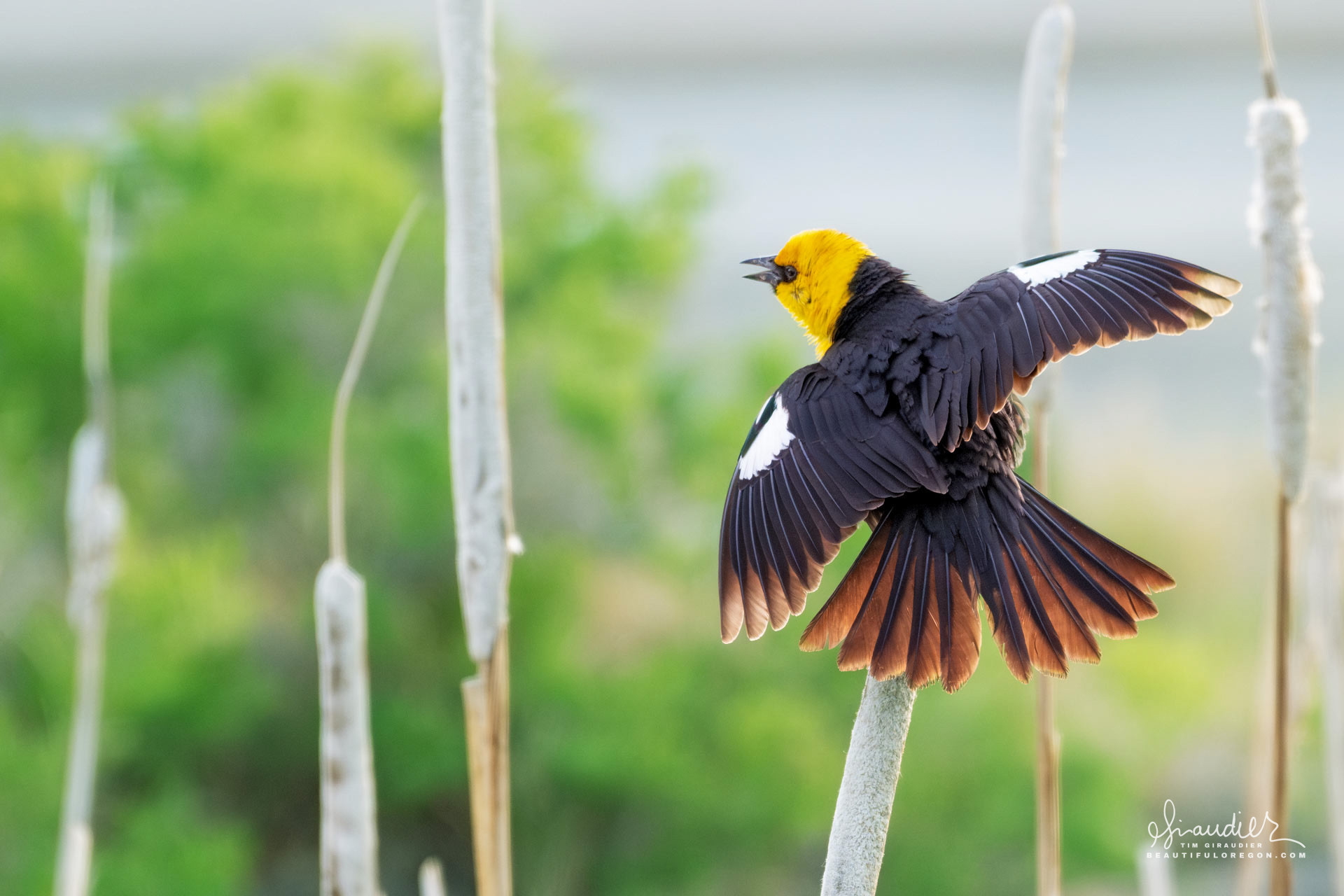
Yellow-headed Blackbird – Summer Lake Wildlife Refuge
$ 49.50
& Free Shipping: UK £40 | EU £50 | Intl £55A Yellow-headed Blackbird (Xanthocephalus xanthocephalus) strikes a beautiful pose, both in defense of territory, and in hope of attracting a mate. Summer Lake Wildlife Refuge, Lake County, Southeastern Oregon. Life History and Behavioral Ecology of the Yellow-headed Blackbird: The Yellow-headed Blackbird is a conspicuous passerine bird native to North America, known for its distinctive yellow head and black body. It inhabits marshes and wetlands, particularly those with dense stands of emergent vegetation. This species exhibits pronounced sexual dimorphism, migratory behavior, and complex social interactions. The Yellow-headed Blackbird is a member of the family Icteridae, which includes other well-known species such as the Red-winged Blackbird (Agelaius phoeniceus) and the Common Grackle (Quiscalus quiscula). As a wetland specialist, the Yellow-headed Blackbird has adapted to a life centered around marshes and shallow water habitats. This species is distributed widely across North America, particularly in the western and central United States and southern Canada, and winters in the southwestern United States and Mexico. Its behavior, especially during the breeding season, is characterized by territorial aggression, colonial nesting, and complex vocalizations. Habitat and Distribution:Yellow-headed Blackbirds primarily inhabit freshwater wetlands with dense stands of cattails (Typha spp.), bulrushes (Schoenoplectus spp.), or similar emergent vegetation. These habitats are typically shallow, permanent or semi-permanent wetlands that provide both nesting sites and foraging opportunities. During the breeding season, these birds are strongly tied to large marshes, often in association with open water, where colonies can establish. In their wintering grounds, however, they exhibit a shift in habitat preference, moving away from marshes and into drier agricultural regions, including open fields and grasslands. This seasonal change in habitat corresponds with shifts in food availability, as wintering birds rely heavily on grains from agricultural areas, while their breeding diet is more insectivorous. Breeding Biology:The breeding season for Yellow-headed Blackbirds typically begins in late spring, when males arrive at wetlands and establish territories in marshes. These territories are fiercely defended, with males displaying aggressive postures and vocalizations to deter rivals. Territorial displays are often accompanied by the male’s characteristic song—a harsh, grating series of notes that is unique in its lack of melodic quality compared to other blackbirds. Males are highly polygynous, often mating with several females within their territory. Females choose nesting sites within the male’s territory, constructing nests from wet plant materials woven into the stems of emergent vegetation, typically over water. The nests are deep, open cups that provide structural stability during wind and fluctuating water levels. Females lay 3 to 5 eggs per clutch and are solely responsible for incubation and early chick care, though males may contribute to territory defense. The eggs hatch after an incubation period of approximately 12 days. Nestlings are altricial and remain in the nest for about 9-12 days, during which time the female provides food—primarily insects—for rapid chick growth. Fledging occurs after the nestlings are sufficiently developed, though they remain dependent on parental care for some time post-fledging. Foraging and Diet: Yellow-headed Blackbirds are opportunistic feeders with a diet that varies seasonally. During the breeding season, their diet consists primarily of aquatic and terrestrial invertebrates, such as dragonfly larvae, beetles, and other marsh-dwelling arthropods. Foraging strategies are diverse; individuals may glean insects from vegetation, snatch prey in flight, or probe into mud for invertebrates. In contrast, during migration and winter, their diet shifts to primarily granivorous foraging. Large flocks of Yellow-headed Blackbirds descend upon agricultural fields to consume grains such as wheat, oats, barley, and corn. This seasonal diet shift coincides with the scarcity of invertebrates during colder months and highlights their adaptability in exploiting human-modified landscapes. Migration and Social Behavior: Yellow-headed Blackbirds are migratory, with breeding populations in Canada and the northern United States traveling to southern regions for the winter. Migration generally occurs in large, gregarious flocks, often composed of mixed species including Red-winged Blackbirds (Agelaius phoeniceus) and Brewer’s Blackbirds (Euphagus cyanocephalus). These flocks can number in the thousands, moving along major migratory flyways that traverse the Great Plains and western regions of North America. During the breeding season, social behavior is characterized by the species’ tendency to form loose colonies. While males establish territories and exhibit strong intra-sexual competition, the species overall maintains a level of sociality not observed in many other territorial species. This colonial breeding structure likely provides benefits such as increased protection from predators and more efficient exploitation of foraging resources. Outside of the breeding season, Yellow-headed Blackbirds are highly gregarious, forming large roosts that often consist of thousands of individuals. These communal roosts are typically located in agricultural fields or reed beds and serve as both foraging sites and protection from predators. Flock dynamics during winter are highly fluid, with individuals moving between roosts in search of food and shelter. Vocalization: The vocal repertoire of Xanthocephalus xanthocephalus is distinctive within the Icteridae family. The male’s primary territorial song is a harsh, guttural series of notes, often described as “mechanical” or resembling the sound of a rusty hinge. This vocalization is typically delivered from an elevated perch within the male’s territory and is often accompanied by visual displays, such as puffing of the yellow head feathers and wing-fluttering. These displays serve both to attract females and to intimidate other males. In addition to the male’s song, both sexes produce a range of calls used in social interactions, predator warnings, and within-flock communication. Vocal communication is particularly important during the breeding season when territories are in close proximity and social interactions between individuals are frequent. Conservation Status: While the Yellow-headed Blackbird is not currently considered threatened, it faces several conservation challenges. Wetland degradation and loss due to agricultural expansion, urbanization, and climate change pose significant threats to its breeding habitat. Many of the large wetlands upon which this species depends are vulnerable to drainage and water diversion, reducing the availability of suitable nesting and foraging sites. In winter, the species is often dependent on agricultural landscapes for food, which can expose them to pesticide use and habitat modification. However, the adaptability of Yellow-headed Blackbirds to human-modified environments has allowed populations to persist, although future changes in land use could negatively impact their populations. The Yellow-headed Blackbird represents a fascinating example of a species that has adapted to the dynamic wetland ecosystems of North America. Its complex behaviors, including polygynous breeding, colonial nesting, and seasonal dietary shifts, highlight the species’ ecological flexibility. However, ongoing threats to wetland habitats and agricultural land-use changes underscore the need for continued monitoring and conservation efforts. Understanding the life history and behavior of Xanthocephalus xanthocephalus is critical for the preservation of this striking bird and the wetland ecosystems it inhabits. Lake County, Southeast Oregon, Summer Lake